
Introduction: The IoT Industry Enters a New Phase
The IoT Industry is transitioning from a period of rapid device deployment to one focused on deep value extraction. Furthermore, the release of the “Action Plan” marks a significant turning point. It guides the sector from the “Internet of Everything” toward a more intelligent and pervasive connectivity model.
By 2026, the IoT Industry has moved beyond early-stage hype and partial applications. Therefore, it is entering a new cycle of systematic, scalable, and intelligent growth. This article explores current trends, technological evolution, and market dynamics shaping the IoT Industry today.

The Evolution of the IoT Industry
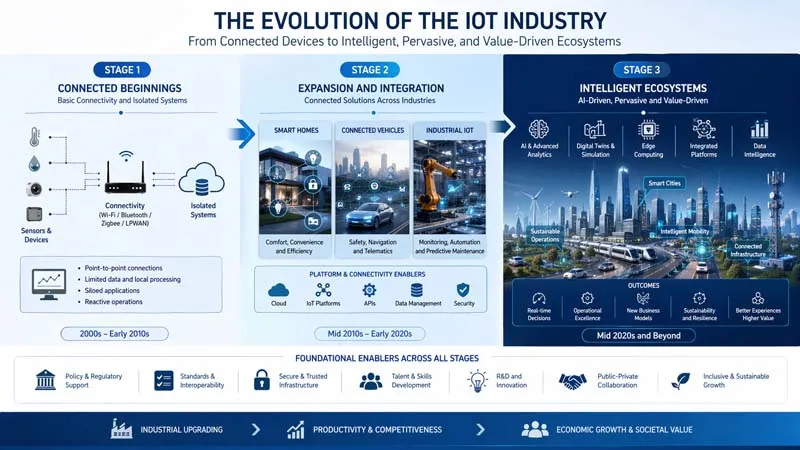
Historically, it has progressed through three key stages. First, the concept incubation stage (around 2010) involved early experiments with sensors, embedded devices, and network protocols. Large-scale deployment remained limited during this period.
Moreover, the expansion phase (2010–2025) saw rapid growth in device adoption across smart homes, industrial IoT, and connected vehicles. Much of this growth focused on scale rather than tangible value. As a result, implementations were often fragmented and isolated. Consequently, the IoT Industry is now poised for a transition toward intelligent and systematic applications. Data-driven insights will create substantial economic and societal value.
Strategic Significance of the Action Plan
The “Action Plan” provides a clear roadmap for it . It emphasizes ecosystem integration, standardization, and cross-industry collaboration. In addition, policies now guide enterprises to focus on data governance, interoperability, and cybersecurity. These measures enable long-term, sustainable growth.
By shifting from device-centric expansion to value-driven innovation, it can develop unified standards. It can also enhance industry coordination and unlock new business opportunities. These steps support scalable and intelligent solutions.
Systematic Development in the IoT Industry
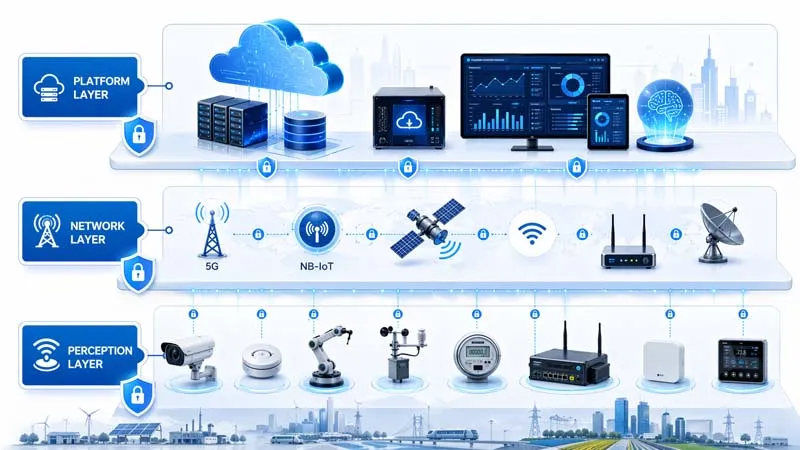
Systematic development is a core trend in it . Technologically, the ecosystem now consists of three layers: perception, network, and platform. The perception layer uses intelligent, low-power sensors to collect high-quality data. Meanwhile, the network layer leverages 5G, 6G, NB-IoT, and satellite communications for wide-area connectivity.
The platform layer combines cloud computing, edge computing, and big data analytics to manage and apply vast data streams. Furthermore, standardization ensures interoperability across devices from different manufacturers. Robust security measures, including encryption and endpoint protection, maintain trust across the IoT network.
Scalable Growth and Industry Applications
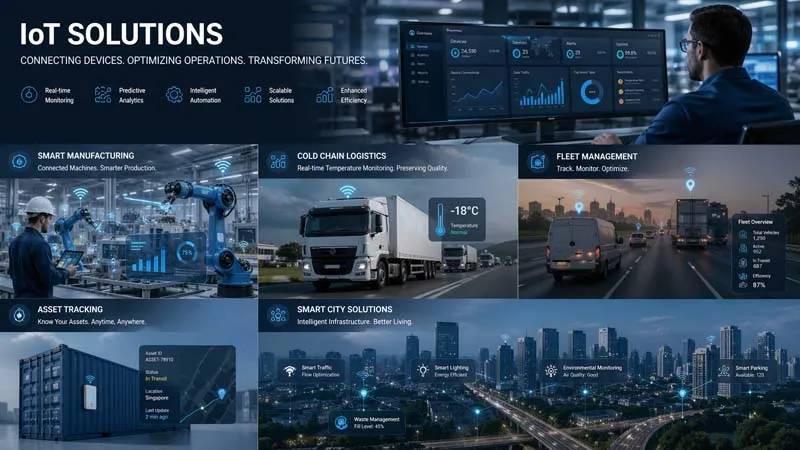
Scalability drives the IoT Industry forward. Industry integration reduces costs and improves efficiency. Upstream and downstream enterprises collaborate to achieve these gains. Moreover, IoT applications expand into smart cities, industrial automation, intelligent transportation, and energy management. Consequently, data-driven services generate additional value for enterprises. They also enhance operational efficiency and customer experiences. Market forecasts indicate that the global IoT Industry will grow steadily through 2030. This growth is fueled by increasing investments, technology adoption, and policy support. Therefore, scalable growth emphasizes both the quantity of connected devices and the depth of applications.
Challenges and Opportunities in the IoT Industry
Despite rapid progress, the IoT Industry faces challenges. These include device heterogeneity, data standardization, network coverage, and cybersecurity risks. Companies must address potential data breaches, regulatory compliance, and evolving privacy standards. At the same time, opportunities abound. AI integration, intelligent service models, and national policy support create conditions for innovation. Thus, businesses can develop new value propositions. They can also transform operations and capitalize on emerging markets. These actions ensure the IoT Industry continues to expand technologically and commercially.
Conclusion: Future Outlook for the IoT Industry
The IoT Industry is entering a new era characterized by systematic organization and scalable growth. From simple device connectivity to intelligent data applications, the sector is undergoing a profound transformation. Leading technology enterprises, such as EELINK Communication, exemplify the industry’s innovation capabilities. With over 20 years of experience, EELINK Communication provides remote monitoring platforms for temperature, humidity, asset management, vehicle security, and cold chain logistics. In addition, their mission is to connect everything through advanced intelligent solutions. They deliver reliable and efficient services that create lasting value.
As the IoT Industry continues to evolve, organizations that embrace systematization, standardization, and scalability will consequently unlock unprecedented opportunities. These steps establish a strong foundation for sustainable growth and innovation.