
AI IoT chip technology drives the transformation of edge intelligence and low-power IoT devices. As a result, traditional cloud-based data processing struggles with latency, efficiency, and security because the number of connected devices grows globally. The nRF92 ultra-low-power edge AI IoT chip tackles these challenges. It integrates an independent NPU, supports micro-ampere power consumption, and performs local AI inference. Consequently, it acts as a key component for logistics tracking, agricultural sensors, and industrial wireless monitoring.
Architecture and Key Features of nRF92
The nRF92 chip features a standalone neural processing unit (NPU). It handles AI inference tasks without relying on the microcontroller. In other words, devices run convolutional neural networks (CNN) and multilayer perceptrons (MLP) efficiently. Meanwhile, the main processor focuses on other operations. Therefore, devices achieve real-time intelligence while consuming minimal power.
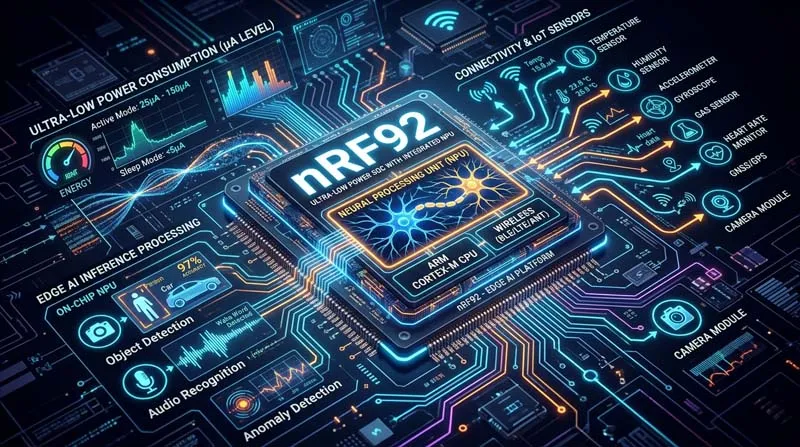
Moreover, nRF92 operates at micro-ampere standby currents. This significantly lowers energy consumption compared to most IoT chips. As a result, devices maintain longer battery life. They also reduce maintenance costs in remote or difficult-to-access locations. The chip supports multiple wireless protocols, including Bluetooth LE, NB-IoT, and LoRa. This ensures stable data transmission across wide-area and low-power networks.
Local AI inference on nRF92 reduces latency and decreases dependence on cloud processing. This approach enhances data privacy and security. Industrial and agricultural applications require rapid, on-site decision-making. nRF92 meets these demands effectively.
Applications in Logistics
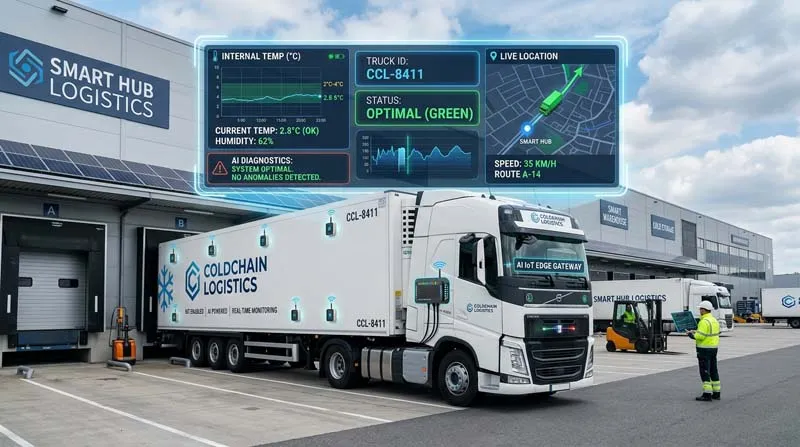
In logistics, the AI IoT chip enables real-time cargo tracking and environmental monitoring. Cold chain transport requires constant supervision of temperature, humidity, and location. With nRF92, sensors analyze data locally using the NPU. They detect anomalies instantly. If temperature thresholds exceed limits or routes deviate, the system triggers immediate alerts. Thereby, it ensures product safety.
Furthermore, ultra-low power consumption extends the operational life of tracking devices. This reduces the frequency of maintenance. Compared to traditional IoT systems that rely heavily on cloud analysis, nRF92 empowers faster decision-making. It also ensures more reliable monitoring in warehouses and transportation networks.
Applications in Agriculture
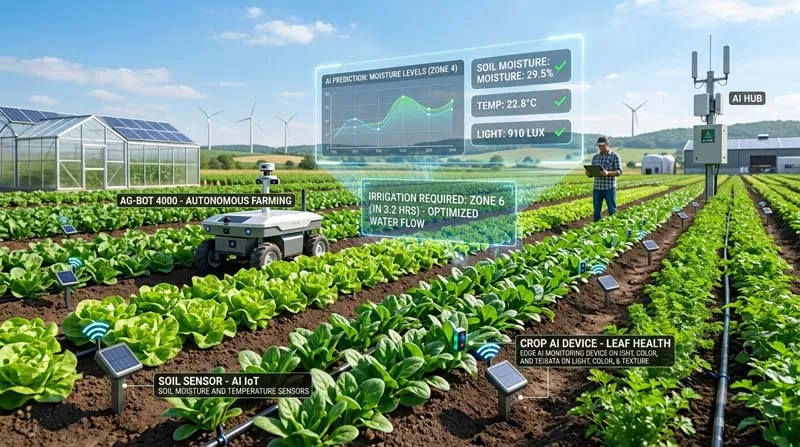
Agricultural sensors benefit from AI IoT chip technology through precise environmental monitoring. nRF92 tracks soil moisture, temperature, light levels, and crop health in real time. Local AI inference predicts irrigation needs and identifies potential disease risks early. Thus, farmers optimize water usage, increase yield, and prevent crop loss.
Remote agricultural nodes face energy and communication constraints. However, the nRF92 chip’s low-power design and edge AI capabilities reduce data transmission frequency. They conserve energy and lower operational costs. In smart greenhouses or autonomous farms, this technology manages resources efficiently while supporting sustainable farming practices.
Applications in Industrial Wireless Monitoring
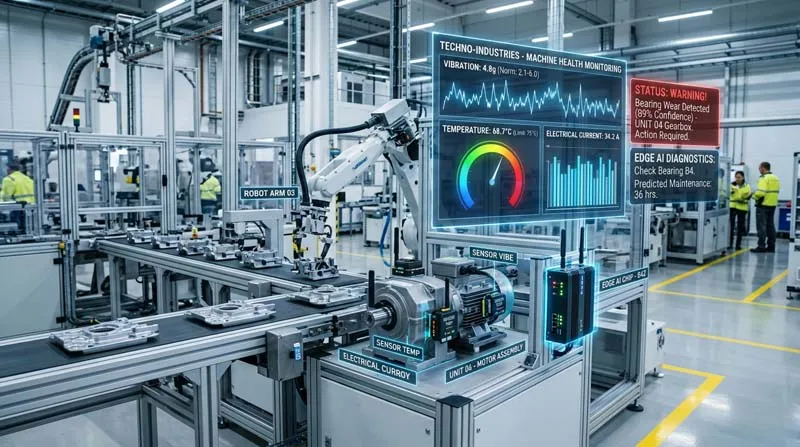
Industrial operations gain substantial benefits from AI IoT chips. nRF92 monitors critical equipment parameters such as vibration, temperature, and electrical current. Edge AI inference predicts potential equipment failures so that operators can implement predictive maintenance proactively. Consequently, factories minimize unplanned downtime. They also improve operational efficiency.
Processing data locally reduces bandwidth usage and decreases reliance on cloud services. It accelerates decision-making. In production lines and pipeline monitoring, nRF92 enhances automation, operational safety, and therefore overall system performance.
Industry Impact and Future Potential
The AI IoT chip reshapes logistics, agriculture, and industrial IoT ecosystems. By integrating low-power design, edge AI, and multi-protocol connectivity, nRF92 upgrades existing devices and enables intelligent sensor networks. It reduces manual interventions, accelerates automation, and as a result, delivers measurable value across industries.
As AI algorithms and chip technology evolve, edge AI chips expand into more scenarios. They enable faster, more reliable local decision-making. Therefore, these chips become essential components in the IoT landscape. They drive innovation and efficiency across connected industries.
Conclusion
The AI IoT chip, with its independent NPU, ultra-low-power design, and local AI inference, provides advanced solutions for logistics tracking, precision agriculture, and industrial monitoring. On-device intelligence boosts operational efficiency. It extends device lifetime and at the same time protects data. As edge AI technology progresses, the nRF92 chip will become a cornerstone of smart IoT devices. Thus, it drives the next wave of industrial and agricultural innovation.
Notably, companies like EELINK Communication demonstrate the impact of IoT innovation. With over 20 years of experience in IoT hardware and software development, EELINK Communication develops solutions for temperature, humidity, asset management, vehicle security, and cold chain logistics. Their mission is to apply smart technologies so that seamless connectivity is achieved, meet evolving customer demands while fostering intelligent, efficient operations.