
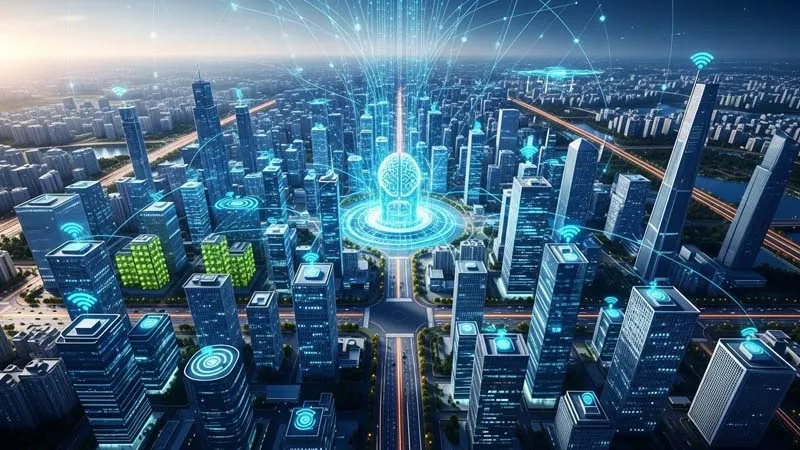
IoT Sensors + AI are reshaping how modern cities sense, understand, and manage complex urban systems. From real-time monitoring to intelligent decision support, this powerful combination has become a foundational pillar of smart city development. As cities grow larger and more connected, IoT Sensors + AI now serve as the central nervous system that enables faster response, smarter planning, and more resilient governance.
The Shift from Digital Cities to Intelligent Governance
In the past, city management depended on manual inspections, delayed reports, and experience-based judgment. However, as urban systems became more complex, these methods revealed clear limits. Information arrived too late, decisions remained fragmented, and risks often escalated before action could begin.
Therefore, IoT Sensors + AI introduce a new governance model. First, sensors collect continuous data across the city. Then, AI analyzes patterns and predicts outcomes. As a result, city managers can move from reactive control to proactive decision-making. This shift greatly improves efficiency, safety, and coordination.
IoT Sensors: Building the Urban Perception Layer
IoT sensors form the foundation of smart city intelligence. They operate as digital nerve endings distributed throughout urban space.
Multi-Dimensional City Awareness
IoT sensors monitor air quality, weather conditions, water levels, traffic flow, infrastructure health, and equipment status. Because of this coverage, city operations become visible and measurable in real time.
Continuous and Real-Time Data Collection
Unlike manual inspections, IoT sensors work continuously and automatically. Moreover, they deliver high-frequency data streams that support advanced AI analysis. Without this perception layer, intelligent city management would remain impossible.
AI: Transforming Data into Urban Intelligence
While IoT sensors enable cities to observe, AI allows cities to understand and act. With massive and fast-changing data, human analysis alone cannot keep pace. Therefore, AI plays a critical role.
From Monitoring to Prediction
AI models analyze historical and real-time data to detect trends and anomalies. Consequently, cities can predict traffic congestion, infrastructure failures, or disaster risks before they escalate.
Smarter Decision Support
Urban management often involves balancing safety, efficiency, and cost. In this context, AI evaluates multiple variables at once. As a result, IoT Sensors + AI provide optimized recommendations instead of simple alerts.
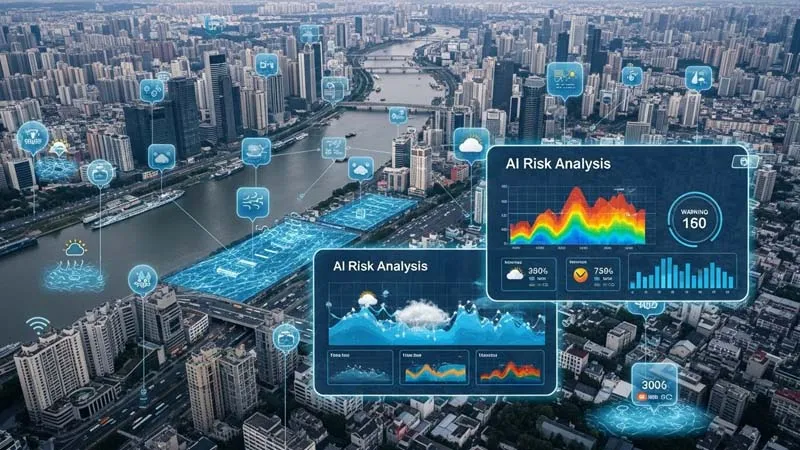
Disaster Detection and Early Risk Warning
Natural disasters cannot be fully avoided, but losses can be reduced. The key lies in early detection and informed decisions.
IoT sensors capture early signals from geological, hydrological, and weather systems. Meanwhile, AI evaluates abnormal patterns and estimates potential impact. Therefore, cities gain valuable time to prepare resources, issue warnings, and reduce damage.
Intelligent Emergency Response and Coordination
Emergency response often suffers from slow information flow and poor coordination. However, IoT Sensors + AI significantly improve this process.
During emergencies, sensors provide real-time situational data. At the same time, AI analyzes personnel location, traffic access, and resource availability. As a result, command centers receive clear and actionable response plans, which shortens reaction time and improves outcomes.

Smart Traffic Optimization and Control
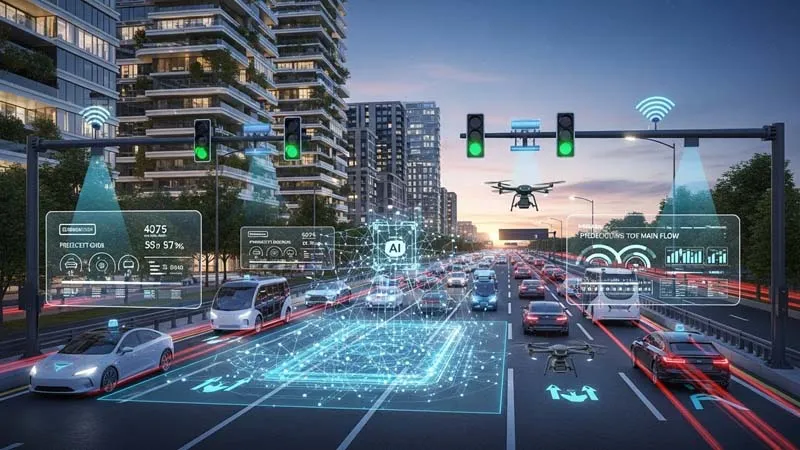
Urban traffic systems are complex and highly dynamic. Traditional static control methods often fail under changing conditions. However, IoT Sensors + AI enable adaptive traffic management.
Sensors collect real-time traffic volume and speed data. Then, AI predicts congestion and adjusts signal timing dynamically. In addition, it supports route guidance and travel optimization. Over time, this approach reduces congestion, lowers emissions, and improves mobility.
Building a Closed-Loop Smart City System
A truly intelligent city operates through a closed loop of perception, analysis, decision-making, and execution.
IoT sensors provide reliable data input. AI delivers analysis and prediction. Finally, management systems turn decisions into action. However, data standards, system security, and human oversight remain essential to ensure trust and transparency.
The Future of Smart Cities and Reliable Connectivity
As smart cities continue to evolve, IoT Sensors + AI will become more precise, adaptive, and resilient. They not only enhance operational efficiency but also support people-centered governance.
At the same time, stable wireless communication remains critical for large-scale IoT deployment. In this context, EELINK Communication provides strong technical support. EELINK Communication is a high-tech company focused on applying wireless communication technologies to IoT solutions. With more than 20 years of experience in IoT hardware and software development, EELINK offers reliable platforms for temperature and humidity monitoring, asset management, vehicle security, insurance services, and cold chain logistics. Through continuous innovation, EELINK helps ensure efficient and dependable connectivity across diverse IoT applications.
From urban perception to intelligent decision-making, IoT Sensors + AI are redefining how cities operate. Supported by reliable communication technologies, smart cities are moving toward a safer, more efficient, and more intelligent future.