Introduction: Healthcare Moves from Treatment to Early Warning
Remote Monitoring IoT is changing how healthcare systems observe, judge, and respond to patient risk. For years, many care models depended on hospital visits, periodic tests, and delayed reports. However, patients with chronic disease need continuous attention. Older adults also need safer support outside major hospitals. Therefore, healthcare must move from passive treatment to active monitoring.
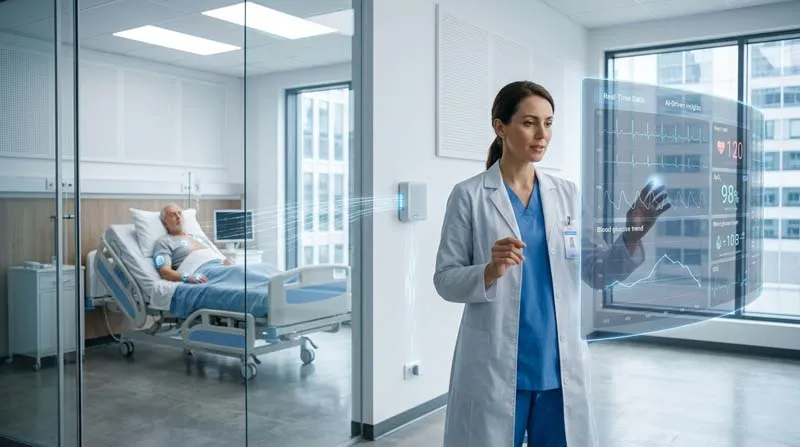
This shift gives smart healthcare a clear direction. Medical data must follow the patient, not remain inside one hospital room. As a result, 5G, edge AI, sensors, and cloud platforms now work together. They help doctors see health changes earlier. They also help primary hospitals act faster when risk appears.
What Remote Monitoring IoT Means
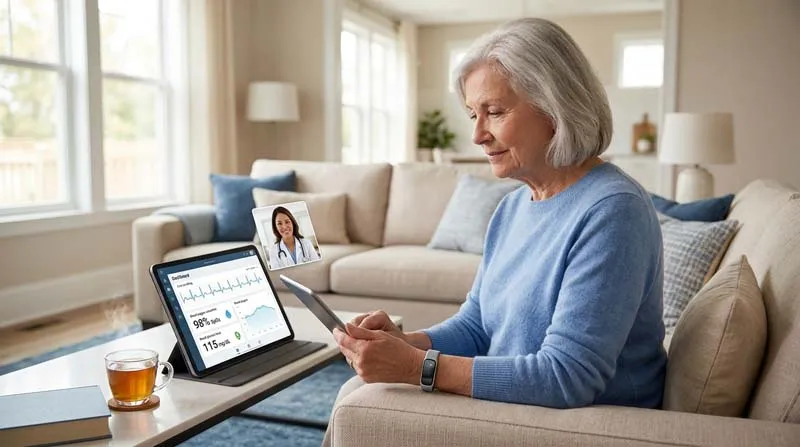
Remote Monitoring IoT connects medical sensors, wearable devices, bedside monitors, communication networks, edge servers, and healthcare platforms. Together, these parts collect and analyze vital signs. They can track ECG, blood oxygen, blood glucose, blood pressure, body temperature, and other health data.
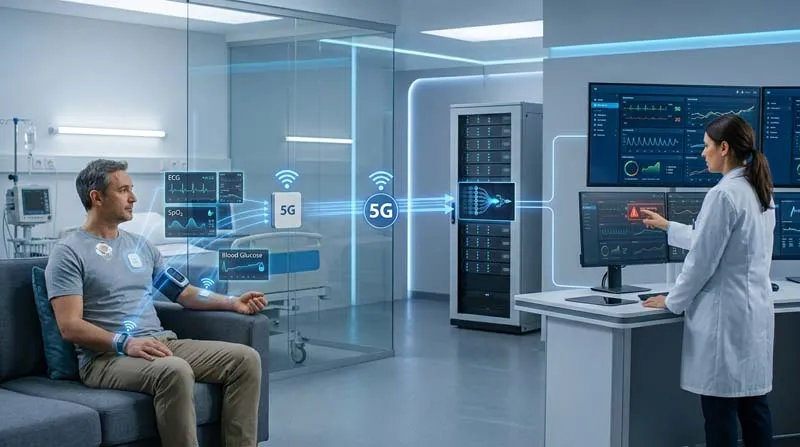
In practice, the system follows a clear path. First, devices collect patient data. Then, 5G networks send that data with low delay. Next, edge AI checks abnormal signals near the medical site. Finally, doctors receive alerts, review the case, and give guidance. Because of this closed loop, care becomes faster and more organized.
Remote Monitoring IoT does not replace doctors. Instead, it helps doctors focus on urgent signals. It turns scattered data into useful medical insight.
5G Builds the Network Foundation
5G gives smart healthcare a stronger connection layer. It offers high bandwidth, low latency, and massive device access. Therefore, hospitals can connect many monitors, wearables, and local medical terminals at the same time.
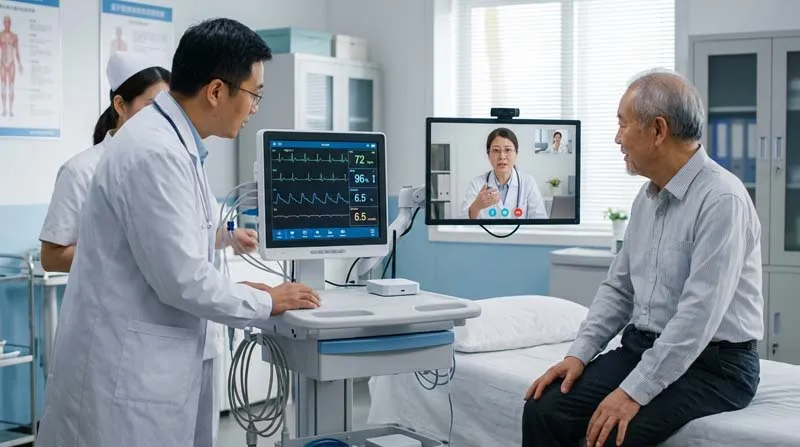
High bandwidth supports more data types. For example, it can support multi-parameter monitoring, video consultation, and medical image transfer. Low latency also matters. When a patient shows signs of arrhythmia or low oxygen, seconds can affect the response. Meanwhile, massive access helps primary hospitals manage many connected devices.
Remote Monitoring IoT needs this stable network base. Without reliable communication, even the best sensor or AI model loses value. With 5G, data can move faster and more smoothly between patients, primary hospitals, and expert teams.
Edge AI Makes Warnings Faster
Cloud platforms still play an important role in healthcare. However, not every signal should wait for distant cloud processing. Edge AI solves this problem. It places AI models near hospitals, local medical sites, or device gateways. As a result, the system can judge risk closer to the patient.
This design reduces delay. It also reduces pressure on network transmission. Moreover, it improves service stability when the network changes. For sensitive signals, such as abnormal ECG, oxygen decline, or blood glucose fluctuation, edge AI can deliver earlier warnings.
Remote Monitoring IoT gains more value when edge AI joins the system. It no longer only records data. Instead, it helps identify patterns, rank risk, and support clinical review.
A Practical Case in Smart Healthcare
Huawei and Xiehe Hospital have explored a 5G and edge AI model for remote patient monitoring. The system focuses on real-time ECG, blood oxygen, and blood glucose monitoring. According to the case data, abnormal warning accuracy reached 98%. The model also covered more than 300 primary hospitals.
These figures show three important points. First, the system can support clinical risk recognition. Second, it can scale beyond one pilot hospital. Third, it can extend medical support to local institutions.
Remote Monitoring IoT creates this impact through collaboration. Patient-side devices collect data. Primary hospitals provide local care. Edge AI screens abnormal signals. Expert doctors review complex cases. Therefore, the whole system forms a practical medical service chain.
Better Early Warning for Patients
Early warning remains one of the strongest values of Remote Monitoring IoT. Many medical risks do not appear during a scheduled visit. They often appear at home, during sleep, after medicine, or during daily activity. So, occasional tests may miss important changes.
Continuous monitoring can reveal risk trends. For example, repeated oxygen decline may suggest respiratory stress. Frequent ECG abnormality may suggest cardiac risk. Sharp glucose swings may show unstable disease control. In each case, timely alerts help doctors act sooner.
This change improves patient safety. It also improves the doctor’s work process. Instead of searching through large amounts of raw data, doctors can focus on filtered alerts and clinical priorities.
Stronger Support for Primary Hospitals
Primary hospitals often face heavy pressure. Many have limited specialist resources. Some also lack advanced monitoring tools. Therefore, they need reliable digital support from larger hospitals and technology systems.
Remote Monitoring IoT helps build that support. Primary hospitals can collect patient data and manage follow-up care. Meanwhile, expert hospitals can guide complex cases through remote platforms. Edge AI can also help local teams identify high-risk signals before conditions worsen.
This structure supports tiered diagnosis and treatment. Patients can receive care closer to home. At the same time, experts can focus on cases that truly need higher-level review. As a result, medical resources can flow more efficiently.
Chronic Disease Management Becomes Continuous
Chronic disease management needs long-term observation. A single hospital test cannot show the full picture. For patients with heart disease, diabetes, respiratory disease, or age-related risk, daily trends matter.
Remote Monitoring IoT helps doctors view these trends. It can show how vital signs change over days, weeks, or months. Therefore, treatment decisions can rely on more complete data. Doctors can adjust medication, follow-up plans, and lifestyle advice with better evidence.
This model also improves patient engagement. When patients see their data, they may understand their health better. Moreover, families and care teams can respond earlier when risk indicators change.
Data Security and Clinical Reliability Matter
Smart healthcare must protect patient trust. Health data involves privacy, safety, and medical responsibility. Therefore, every Remote Monitoring IoT system needs strong data encryption, access control, and audit mechanisms.
Data standards also matter. Devices from different brands should connect with hospital platforms in a consistent way. Otherwise, data islands may appear again. In addition, AI models need continuous clinical validation. High accuracy in one project does not remove the need for long-term testing.
Doctors must keep final decision authority. AI can screen, remind, and support. However, clinical diagnosis and treatment still require professional judgment. This balance protects both innovation and patient safety.
The Future of Connected Healthcare
The next stage of Remote Monitoring IoT will move beyond single indicators. Systems will combine ECG, oxygen, glucose, movement, sleep, images, and medical records. Consequently, healthcare platforms will understand patient risk from more dimensions.
Prediction will also improve. Future systems will not only detect current abnormal signals. They may also predict risk trends before a serious event. In addition, remote monitoring will connect with electronic medical records, telemedicine, rehabilitation, and follow-up systems.
This future depends on more than technology. It also depends on medical workflow, data governance, staff training, and service design. Therefore, successful smart healthcare requires a full ecosystem.
Conclusion: A Smarter and More Accessible Care Model
Remote Monitoring IoT gives smart healthcare a practical path forward. It connects patients, primary hospitals, expert teams, devices, data, and AI. More importantly, it moves care closer to real life. Patients gain earlier warnings. Doctors gain clearer signals. Primary hospitals gain stronger support.
As 5G and edge AI continue to mature, healthcare will become more proactive, precise, and accessible. The real value of smart healthcare does not lie in technology alone. It lies in safer services, faster response, and more continuous protection for every patient.
EELINK Communication is a high-tech company that applies wireless communication technology to the Internet of Things. The company has a leading team with more than 20 years of experience in IoT hardware and software development. Its products include remote temperature and humidity monitoring platforms. Its services also cover asset management, vehicle anti-theft, insurance sales, and cold chain transportation management. Through innovative intelligent technology, EELINK Communication helps customers build efficient and reliable IoT solutions for changing business needs.