
The IoT Chip has become the power core of intelligent connectivity. In 2026, connected devices keep scaling fast, and the requirements shift just as quickly. Low power still matters. Yet now, intelligence, openness, and sustainability matter just as much.
As a result, the IoT Chip is moving beyond “connect and report.” It is evolving into “sense, infer, adapt, and protect.” Moreover, policy pressure and carbon rules reshape how teams design silicon. Meanwhile, edge AI demand pushes more compute into milliwatt budgets.
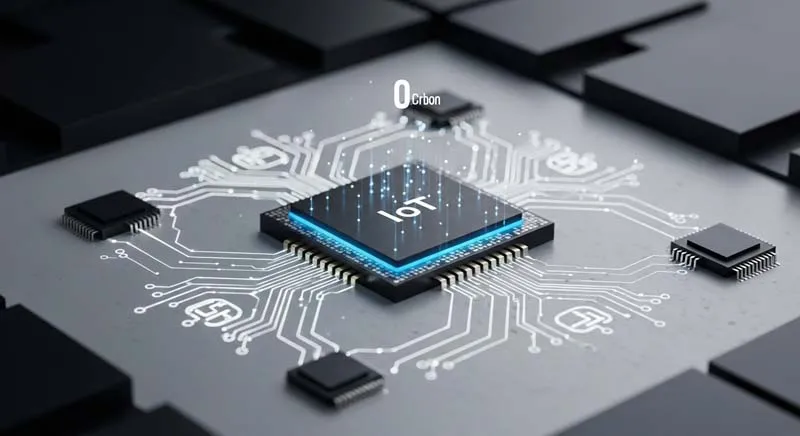
The 2026 Turning Point for IoT Chip Design
For years, mainstream designs centered on low-power MCUs and stable links. They did that job well. However, the market has changed. Edge workloads are rising, and cloud-only processing feels slow and costly. Therefore, on-device inference becomes a practical requirement, not a bonus.
At the same time, supply-chain risks and licensing costs drive a new mindset. Consequently, open architectures gain attention. In addition, carbon targets push teams to measure emissions across the full lifecycle. So the IoT Chip roadmap now blends performance-per-watt with compliance and long-term resilience.
AI Awakening—Low-Power Intelligence Moves On-Chip
Always-on inference, without always-on energy cost
AI awakening is the most visible leap in IoT Chip evolution. Instead of sending everything to the cloud, devices increasingly run small models locally. That change reduces latency. It also protects privacy. And it cuts bandwidth costs.
To enable this, designers embed lightweight NPUs, vector extensions, or DSP-like accelerators into SoCs. They also rely on INT8 and INT4 quantization to keep inference efficient. In many deployments, energy efficiency improves by orders of magnitude. Meanwhile, standby power targets drop toward microwatt levels.

From passive response to proactive decisions
Because local AI can run continuously, devices can react earlier. For instance, anomaly detection can trigger alerts before failures escalate. Likewise, audio or vision intelligence can filter noise and keep only meaningful events.
In industrial environments, this supports predictive maintenance. In healthcare and automotive settings, it strengthens local privacy. However, challenges remain. Thermal constraints still limit sustained workloads. Toolchains for AI-ready design also need to mature. Even so, event-driven computing and memory-centric approaches are gaining traction.
Therefore, the IoT Chip is no longer just a connectivity engine. It is becoming an intelligent edge decision unit.
Chiplet Openness—Modular Architectures Reshape the Stack
A “Lego” approach to building silicon
Chiplet design changes how teams build an IoT Chip. Instead of one monolithic die, chiplets split compute, memory, and I/O into modular blocks. Standard interfaces enable these blocks to work together.
This modularity lowers non-recurring engineering risk. It can improve yield. It also allows selective upgrades. So a team can refresh one module without redesigning the entire SoC. As chiplet ecosystems mature, adoption can spread from high-end segments into broader edge markets.
Faster iteration for vertical solutions
Modular design also fits vertical IoT needs. Different industries need different mixes of compute, security, and radios. Therefore, chiplets can support “right-sized” configurations. Moreover, they encourage specialization, since smaller teams can innovate on a single module.
In practice, this flexibility helps build heterogeneous systems. You can combine CPU, NPU, and security blocks more efficiently. As a result, performance-per-watt improves while product differentiation becomes easier.
RISC-V Momentum—Open Instruction Sets Enable Custom Differentiation
RISC-V complements chiplets in a direct way. It removes licensing fees. It also supports modular extensions. So teams can tailor compute to specific workloads.
For the IoT Chip, this matters because edge devices need tight optimization. In addition, vector extensions can handle AI and DSP tasks more efficiently. Consequently, RISC-V lowers entry barriers for low-power innovation and encourages ecosystem growth.
Of course, openness brings new responsibilities. Security and verification must be strong. Toolchains must be reliable. Yet the momentum is clear: open instruction sets are becoming a strategic lever for cost control and supply-chain independence.
Zero-Carbon Rebirth—Sustainability Becomes a Design Constraint
Carbon is now part of the spec sheet
Zero-carbon design is no longer a “nice to have.” For the IoT Chip, sustainability now touches materials, manufacturing, packaging, and operational power. Carbon disclosure and compliance pressures are rising. Therefore, lifecycle optimization becomes a competitive capability, not just a corporate slogan.
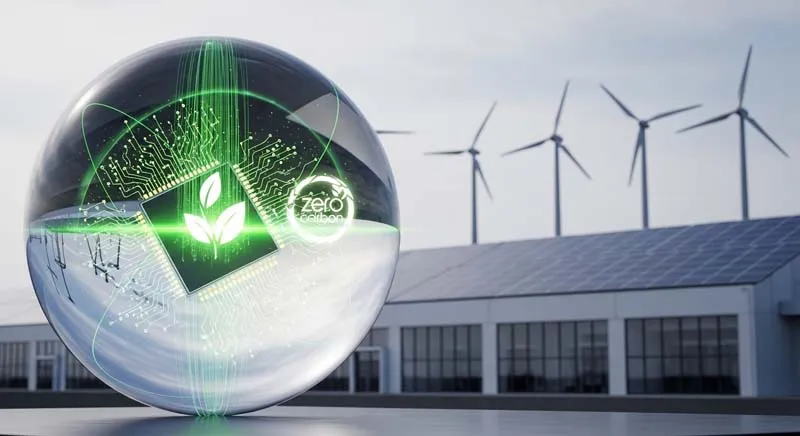
Practical design moves that reduce emissions
Teams pursue multiple paths at once. First, they push passive or ultra-low-power architectures to reduce operational energy. Second, they improve process efficiency through smarter node choices and packaging decisions. Third, they integrate carbon accounting into design workflows, so trade-offs become measurable.
Battery life also becomes a sustainability metric. Devices targeting multi-year or even decade-long operation reduce replacement waste and maintenance travel. Moreover, event-driven behavior lowers standby consumption further.
So the IoT Chip is entering an era where green design supports both compliance and market trust.
How the Three Trends Reinforce Each Other
These shifts do not happen in isolation. Low-power AI increases compute demand. Chiplets offer a flexible way to deliver that compute. Meanwhile, carbon constraints shape how that compute gets built and deployed.
Together, they form a closed loop:
- AI needs efficiency and specialization.
- Openness enables faster customization.
- Zero-carbon targets enforce long-term discipline.
As a result, the next-generation IoT Chip becomes AI-native, modular, and carbon-aware by default.
What This Means for Real-World IoT Markets
This evolution will reshape product strategies across multiple sectors. Industrial IoT benefits from smarter monitoring and predictive maintenance. Smart homes gain local intelligence and quicker responses. Connected vehicles improve real-time sensing and privacy. Smart cities scale edge analytics without overwhelming networks.
However, the industry must manage real risks. Design complexity will keep rising. Security-by-design must become standard practice. Ecosystem fragmentation is also possible. Yet these challenges create opportunities for standards alignment, shared platforms, and cross-domain partnerships.
Outlook to 2030—From Connectivity Dividends to Value Dividends
Looking ahead, the IoT Chip will underpin embodied intelligence, physical AI, and low-carbon economies. It will move the industry from “more connections” to “more value per connection.” Therefore, the winners will combine engineering discipline with ecosystem collaboration.
Companies that invest in standards, security, and lifecycle sustainability will build stronger trust. Meanwhile, teams that master low-power edge AI will unlock the next wave of differentiated products.
In short, the IoT Chip is becoming the brain, not just the modem—and it will define how intelligent connectivity scales responsibly.