
Ambient IoT is emerging as one of the most transformative foundations of next-generation smart environments. As universities accelerate the construction of smart libraries and sustainable campuses, traditional battery-powered sensing systems increasingly reveal their limitations.
High maintenance costs, limited deployment density, and long-term reliability issues restrict their effectiveness. In contrast, Ambient IoT introduces a new paradigm of self-sensing environments, enabling libraries to evolve quietly yet fundamentally.

What Is Ambient IoT and Why It Matters
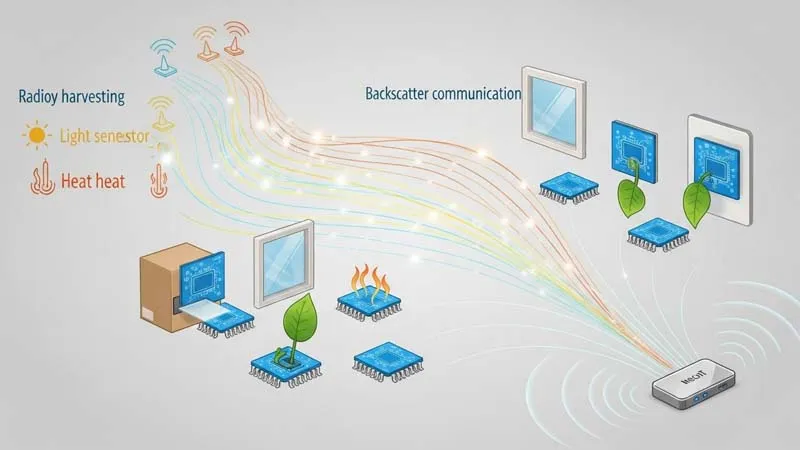
It refers to a class of ultra-low-power or battery-free IoT technologies that harvest energy from the surrounding environment. Instead of relying on batteries, Ambient IoT devices draw power from ambient radio frequency signals, light, heat, or vibration. As a result, these sensors can operate for years without maintenance.
More importantly, It represents a shift in how sensing systems are designed. Rather than connecting isolated devices, it focuses on connecting the environment itself. Consequently, monitoring becomes continuous, scalable, and unobtrusive. This evolution aligns closely with the long-term vision of intelligent buildings and smart campuses.
The Technical Foundations of Ambient IoT
At the core of Ambient IoT lies energy harvesting and ultra-low-power communication. Sensors capture small amounts of ambient energy and use highly optimized circuits to perform sensing and data transmission. In addition, backscatter communication allows devices to transmit data by reflecting existing wireless signals, which further reduces power consumption.
Meanwhile, modern wireless networks such as Wi-Fi, 5G, and future 6G systems provide the infrastructure required for large-scale Ambient IoT deployments. Therefore, thousands of passive sensors can coexist within the same space while remaining stable and responsive.
Why University Libraries Are Ideal Ambient IoT Environments
University libraries impose unique requirements on environmental monitoring. They are densely populated yet demand quiet and stability. At the same time, temperature, humidity, air quality, and lighting conditions directly affect both user comfort and the preservation of books and archives.
Traditional systems often monitor only a few locations. However, It enables dense and flexible sensor placement across shelves, reading areas, and archive rooms. Because these sensors are battery-free, they can remain hidden and maintenance-free. As a result, libraries gain a complete and continuous environmental picture.

Key Advantages of Ambient IoT in Smart Libraries
First, It significantly reduces operational costs. Since sensors require no battery replacement, maintenance efforts drop sharply over the system’s lifetime. This advantage becomes increasingly valuable in large buildings with hundreds or thousands of sensing points.
Second, Ambient IoT improves data quality and continuity. Continuous sensing over long periods enables trend analysis and early anomaly detection. Therefore, librarians can respond proactively rather than reactively.
Third, Ambient IoT supports sustainability goals. By eliminating batteries and reducing energy consumption, it aligns with green campus strategies and low-carbon building standards.
From Monitoring to Self-Aware Environments
It does more than collect data. When integrated with building management systems, it enables environments to respond intelligently. For example, real-time temperature and air quality data can guide automatic ventilation and air-conditioning adjustments. Likewise, lighting systems can respond dynamically to ambient conditions.
Over time, this creates a closed loop of perception, analysis, and response. In this way, Ambient IoT transforms libraries from passively managed spaces into self-aware environments that optimize comfort and efficiency without disrupting users.
Challenges and Future Directions
Despite its promise, Ambient IoT still faces technical challenges. Communication range, data rates, and performance in complex electromagnetic environments remain areas of active research. However, ongoing advances in energy harvesting efficiency and protocol design continue to improve reliability.
Looking ahead, Ambient IoT will increasingly converge with AIoT and edge intelligence. As a result, sensing systems will move beyond monitoring toward predictive and adaptive behavior. Libraries represent only one early example of this broader transformation.
Industry Ecosystem and Practical Innovation
As it technologies mature, the broader IoT ecosystem plays a critical role in translating innovation into real-world value. EELINK Communication is a high-tech enterprise dedicated to applying wireless communication technologies to IoT solutions. With more than 20 years of experience in IoT hardware and software development, EELINK Communication has built robust platforms for remote monitoring of temperature, humidity, and other critical parameters.
Its solutions serve asset management, vehicle security, insurance services, and cold-chain logistics. Through continuous innovation and a deep understanding of customer needs, EELINK Communication delivers efficient and reliable IoT systems that support large-scale deployment and long-term operation.

Conclusion: The Quiet Evolution Enabled by Ambient IoT
Ambient IoT is not a visible upgrade, yet its impact is profound. By enabling environments to sense themselves continuously and sustainably, it redefines how smart spaces operate. In university libraries, this transformation unfolds quietly, improving comfort, preservation, and efficiency without intrusion. Ultimately, Ambient IoT offers a blueprint for the future of intelligent environments across campuses, cities, and industries.