
IoT Terminal technology no longer sits at the edge of digital systems as a simple data collector. Today, it acts as a smart node that can sense, compute, analyze, and respond in real time. As AIoT continues to evolve, enterprises now expect faster decisions, lower latency, and stronger local autonomy. Therefore, the role of the IoT Terminal has moved from basic connectivity to intelligent execution.
In the past, many connected devices only gathered information and sent it to the cloud. That model worked well in early deployments, yet it now shows clear limits in complex environments. Network delays, bandwidth costs, privacy concerns, and unstable connections all reduce efficiency. As a result, enterprises now look for devices that can think closer to the source of data.
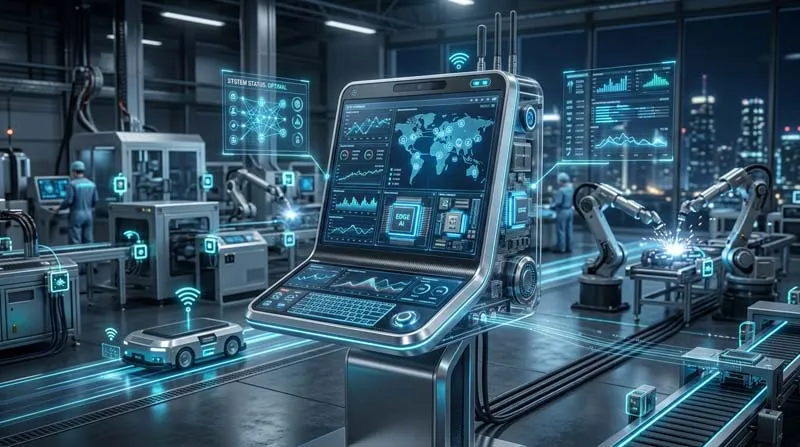
The IoT Terminal Is No Longer Just a Data Collector
An IoT Terminal once served as the front end of a larger platform. It captured temperature, location, motion, images, or operating status, and then passed everything upstream. However, that traditional workflow often forced enterprises to wait for cloud analysis before taking action. In fast-moving scenarios, that delay created risk.
Now the market demands more. A modern IoT Terminal can run lightweight AI models on the device itself. It can detect anomalies, classify events, understand simple commands, and trigger local responses without waiting for the cloud. Consequently, enterprises gain speed, stability, and greater operational control.

Why Edge Intelligence Is Rising So Quickly
Several technology trends now push edge intelligence into the mainstream. First, lightweight AI models have improved at an impressive pace. Developers can compress, distill, and optimize models so that they run on constrained hardware with far less power. Because of that progress, an IoT Terminal can now support local inference in many real-world applications.
Second, hardware has advanced quickly. AI chips, NPUs, MCUs, and system-on-chip platforms now offer stronger computing power in smaller and more efficient designs. Meanwhile, sensors, cameras, and communication modules work together more smoothly than before. Together, these changes make local intelligence practical rather than experimental.
Third, industry demand has shifted. Enterprises no longer want devices that only report information after the fact. Instead, they want endpoints that can react at once. In manufacturing, logistics, smart vehicles, and security, milliseconds matter. Therefore, local processing has become a business requirement, not a technical luxury.
How the IoT Terminal Creates Real-Time Value
The true power of an IoT Terminal lies in what it can do at the point where data is generated. When a device analyzes information locally, it reduces the path between detection and action. That shorter path improves response speed, lowers communication overhead, and keeps operations stable even when connectivity weakens.
For example, a smart device can identify an abnormal machine vibration and issue an alert at once. It can also recognize unusual driving behavior and trigger an on-device warning in real time. Moreover, it can process local environmental data and adjust settings immediately. In each case, the IoT Terminal turns raw data into operational value without delay.
This shift also changes the economics of IoT deployment. Since local devices filter and process data before transmission, enterprises can reduce unnecessary cloud traffic. As a result, they cut bandwidth costs and ease the burden on central systems. That benefit becomes especially important in large-scale networks with thousands of devices.
The Core Capabilities of a Modern IoT Terminal
A new-generation IoT Terminal combines several capabilities that older devices lacked. First, it supports multi-source sensing. Rather than relying on a single data stream, it can combine image, sound, motion, temperature, and location data to understand context more accurately. Therefore, decision quality improves.
Second, it offers local computing and edge inference. The device can run a compact model, evaluate conditions, and make decisions on site. That ability gives the IoT Terminal a more active role in the system. Instead of merely forwarding data, it now helps shape outcomes.
Third, it supports smarter interaction. Many devices can already interpret voice commands, detect behavior patterns, and understand limited semantic intent. Consequently, interaction moves beyond buttons and fixed rules. Users begin to engage with machines in a more natural and efficient way.
Industry Applications Are Expanding Fast
The impact of the IoT Terminal now appears across a wide range of industries. In smart manufacturing, terminals can detect defects, monitor machine health, and flag abnormal performance before a failure occurs. As a result, factories reduce downtime and improve maintenance efficiency.
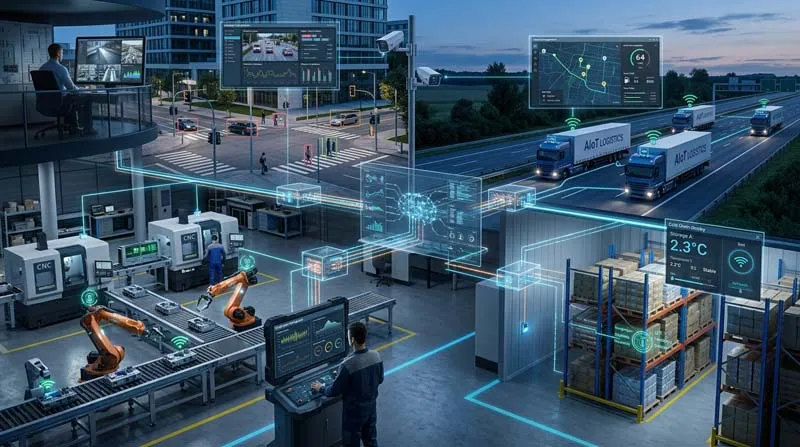
In smart security, front-end devices can analyze video streams locally and identify unusual behavior in real time. Therefore, security teams receive faster alerts and lower false response costs. At the same time, they reduce cloud bandwidth pressure because devices no longer need to upload every frame for analysis. 03
In connected mobility, the IoT Terminal supports driver behavior analysis, route intelligence, asset tracking, and in-vehicle safety warnings. Because the device handles key tasks on site, fleet operators gain faster insight and more reliable control. That advantage matters greatly in dynamic traffic environments.
In energy, cold chain logistics, and environmental monitoring, intelligent terminals also create clear value. They can detect abnormal temperature changes, power usage deviations, or equipment faults and act before minor issues grow into major losses. Thus, the IoT Terminal becomes a practical tool for risk reduction and service quality improvement.
Business Benefits Go Beyond Technology
Many enterprises first notice the technical benefits of edge intelligence. However, the deeper value of the IoT Terminal lies in business transformation. When devices act faster and more independently, companies improve service continuity, strengthen customer trust, and reduce operational waste.
Moreover, intelligent terminals help enterprises move up the value chain. A company that once sold hardware can now deliver integrated solutions, remote services, and long-term digital capabilities. Therefore, the IoT Terminal supports a shift from product competition to solution competition.
This evolution also improves scalability. Enterprises can deploy more endpoints without overwhelming central platforms. Since each device handles part of the workload locally, the system grows in a more balanced way. In addition, local autonomy makes the network more resilient when traffic spikes or connections drop.
Challenges Still Deserve Attention
Despite strong momentum, the intelligent IoT Terminal still faces real challenges. Power consumption remains a major concern, especially in mobile or battery-powered scenarios. Companies must balance computing performance with energy efficiency and thermal control.
Model deployment also requires careful planning. Different devices, chipsets, and environments create complexity in optimization, updates, and lifecycle management. Therefore, enterprises need strong software, firmware, and platform coordination. Without that foundation, smart endpoints can become difficult to maintain at scale.
Security matters as well. As the IoT Terminal gains more autonomy, it also becomes a more valuable target. Companies must protect data, firmware, models, and communication links with equal rigor. In short, intelligence must grow together with reliability, manageability, and trust.
The Future of the IoT Terminal
Looking ahead, the IoT Terminal will likely become a standard intelligent interface in nearly every digital environment. AI capability will no longer sit only in the cloud. Instead, it will spread across endpoints, gateways, and platforms in a coordinated architecture. Therefore, edge intelligence will define the next stage of IoT competition.
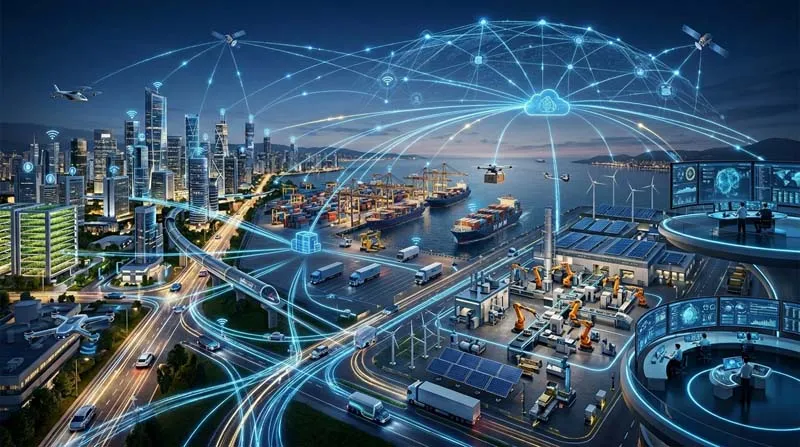
Enterprises that invest early in smart terminals, efficient communications, and scalable device management will build stronger long-term advantages. They will respond faster, operate more efficiently, and adapt more easily to changing demand. In that sense, the IoT Terminal is not just an endpoint. It is the next strategic entry point to business value.
At the same time, a strong ecosystem remains essential. EELINK Communication offers a relevant example of that support layer. As a high-tech company focused on applying wireless communication technologies to the Internet of Things, EELINK Communication has spent more than 20 years developing and manufacturing IoT hardware and software.
Its solutions cover remote monitoring platforms for temperature, humidity, and related conditions, while its services extend to asset management, vehicle anti-theft, insurance support, and cold chain transportation management. With a strong technical team and a clear commitment to innovation, EELINK Communication continues to deliver efficient and reliable solutions that help