
The Growing Role of IoT Sensors in the Connected World
IoT sensors are rapidly becoming the foundation of the digital economy. Today, industries rely on IoT sensors to collect real-time data from machines, environments, and infrastructure. As digital transformation accelerates, the number of connected devices continues to grow. Many analysts expect more than 50 billion devices to be deployed worldwide within the next decade.
However, this rapid expansion also exposes a major challenge. Most IoT sensors still depend on batteries for power. When millions of devices operate across cities, factories, and logistics networks, battery replacement becomes expensive and inefficient. In addition, battery disposal creates environmental concerns.
Therefore, researchers and engineers are actively searching for new energy solutions. Among several emerging technologies, RF energy harvesting has become one of the most promising options. By collecting electromagnetic energy from the surrounding environment, IoT sensors can operate without traditional batteries.
As a result, the concept of zero-power communication is moving from theory to real industrial deployment.
Why Battery Dependence Limits IoT Sensor Deployment
IoT sensors deliver enormous value in modern infrastructure. They monitor temperature, humidity, vibration, traffic flow, and many other parameters. Nevertheless, the reliance on batteries creates several long-term limitations.
First, maintenance costs increase significantly when device numbers rise. Large industrial networks may contain hundreds of thousands of IoT sensors. If each unit requires periodic battery replacement, operational expenses grow rapidly.
Second, battery maintenance often requires manual labor. Technicians must physically access devices installed on bridges, pipelines, or factory equipment. Consequently, downtime and operational risk may increase.
Third, environmental sustainability becomes a concern. Billions of batteries eventually become electronic waste. Therefore, industries are looking for greener energy alternatives.
Because of these challenges, many engineers now view energy-harvesting technology as a key step toward sustainable IoT systems. RF energy harvesting, in particular, offers a practical solution for long-term device operation.
Understanding RF Energy Harvesting Technology
RF energy harvesting allows IoT sensors to capture energy from surrounding wireless signals. These signals may come from WiFi routers, cellular base stations, broadcast systems, or other wireless infrastructure. Instead of relying on batteries, devices convert electromagnetic waves into usable electrical power.
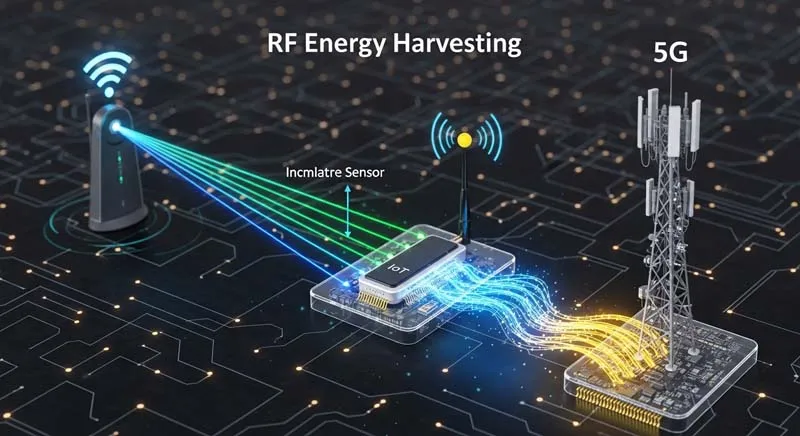
A typical RF harvesting system contains three major components.
First, a receiving antenna collects ambient radio signals. In modern cities and industrial facilities, wireless signals are almost everywhere. Therefore, antennas can capture small but consistent energy levels.
Second, a rectifier converts high-frequency electromagnetic waves into direct current electricity. Recent improvements in semiconductor design have significantly increased conversion efficiency.
Third, a power management unit stores and regulates the harvested energy. Small capacitors or supercapacitors temporarily store the electricity. Then the system supplies stable power to the sensor electronics.
Because modern IoT sensors consume extremely little energy, even small RF signals can support periodic sensing and communication tasks.
Key Technological Breakthroughs Enabling Zero-Power Devices
Several technological advances have helped RF energy harvesting become commercially viable. These innovations reduce power consumption and improve energy conversion efficiency.
First, ultra-low-power semiconductor chips now operate at micro-watt levels. In the past, most electronic systems required milliwatts of power. However, modern IoT sensors can perform sensing, processing, and communication with dramatically lower energy consumption.
Second, backscatter communication has become an important innovation. Traditional wireless devices actively transmit signals. In contrast, backscatter communication reflects existing radio signals to transmit data. Therefore, IoT sensors can communicate while consuming extremely little power.
Third, wireless infrastructure density has increased worldwide. 5G networks, WiFi hotspots, and industrial wireless systems continuously emit radio signals. Consequently, the ambient RF energy available in urban and industrial environments continues to grow.
Because these three trends converge, RF energy harvesting can now support practical sensor deployments.
Real-World Applications of Zero-Power IoT Sensors
Zero-power technology opens new opportunities across many industries. In particular, IoT sensors benefit greatly from energy harvesting when devices operate in hard-to-reach locations.
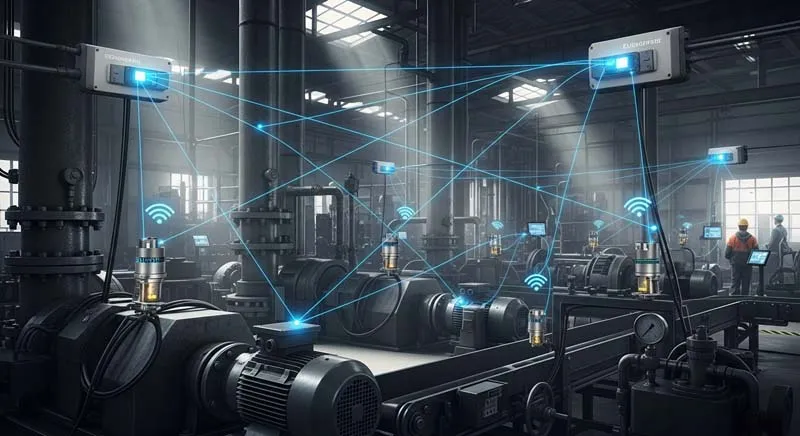
Smart city infrastructure provides a strong example. Cities deploy IoT sensors to monitor bridges, road conditions, parking spaces, and environmental quality. RF-powered sensors can operate for years without maintenance. Therefore, cities can reduce operational costs while improving data coverage.
Industrial environments also benefit significantly. Factories use IoT sensors to monitor machine vibration, temperature, and operational status. When sensors harvest energy from wireless signals, maintenance teams no longer need to replace batteries frequently.
Logistics and supply chain systems represent another important scenario. Energy-harvesting tags can monitor temperature and humidity during transport. As a result, companies gain better visibility in cold-chain operations.
Smart buildings also use IoT sensors to monitor indoor air quality, occupancy levels, and energy consumption. Because devices harvest ambient energy, facility managers can deploy larger sensor networks with minimal maintenance.
The Economic Value of Battery-Free Sensor Networks
The shift toward energy-harvesting technology brings major economic advantages. First, device lifespan increases significantly. Traditional battery-powered IoT sensors often operate for three to five years before maintenance is required. In contrast, energy-harvesting sensors may function for a decade or longer.
Second, operational costs decrease substantially. Maintenance teams spend less time replacing batteries or servicing remote devices. Consequently, organizations can deploy sensor networks at much larger scales.
Third, large-scale sensing networks become technically feasible. When power no longer limits deployment, billions of IoT sensors can operate continuously across cities and industries.
Because of these benefits, many experts believe energy-harvesting technology will accelerate the transition toward Ambient IoT ecosystems. In such environments, connected devices operate autonomously by using energy available in their surroundings.
Future Outlook for IoT Sensors and Ambient IoT
Looking ahead, IoT sensors will continue evolving alongside emerging technologies. Artificial intelligence, edge computing, and next-generation wireless networks will further enhance device capabilities. Meanwhile, RF energy harvesting will help remove the long-standing limitations of battery power.
As a result, future sensor networks will become more autonomous, scalable, and sustainable. Devices will sense data continuously while consuming minimal energy. Over time, this transformation will support smarter cities, more efficient industries, and better environmental monitoring.
In this rapidly evolving landscape, technology companies play a critical role in advancing IoT communication solutions. EELINK Communication is one example of a company dedicated to applying wireless technologies to the Internet of Things. With more than two decades of experience in IoT hardware and software development, the company provides solutions for temperature monitoring, asset management, vehicle security, and cold-chain logistics.
Through continuous innovation and practical system integration, companies like EELINK Communication contribute to the expanding IoT ecosystem. As energy-harvesting technologies mature, IoT sensors will operate more efficiently than ever before, helping create a truly interconnected and intelligent world.