IoT + AI Sensors are changing how modern farms grow, manage, and scale. In the past, many growers relied on manual checks and personal experience. As a result, irrigation often came too early or too late, ventilation lacked precision, and lighting decisions depended on rough judgment. Today, farms can monitor soil, air, and light in real time. Therefore, they can respond faster and manage resources with far greater accuracy.
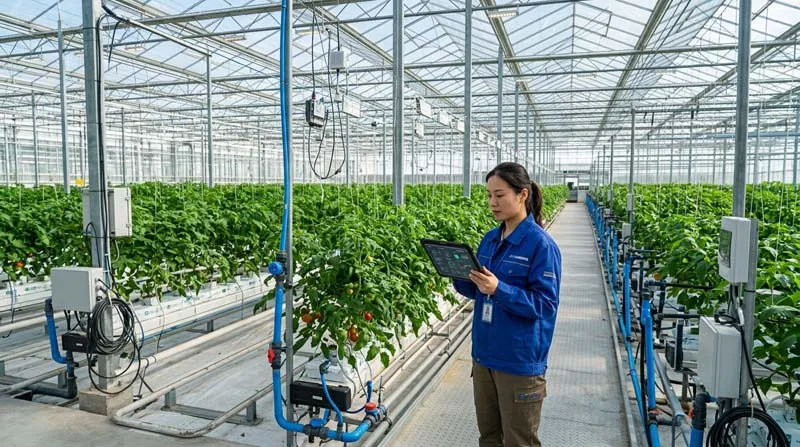
This shift matters because agriculture now faces pressure from rising labor costs, tighter water supplies, and stronger demands for stable output. In this context, IoT + AI Sensors offer a practical path forward. They help farms move from reactive work to proactive control. Moreover, they support a new model of farming built on data, automation, and measurable results.
Why Smart Agriculture Needs a New Operating Model
Traditional farming methods work, but they often struggle under modern production demands. Farmers must track soil moisture, air temperature, humidity, light intensity, and crop condition at the same time. However, manual observation cannot capture these changes continuously. Small delays can lead to water waste, poor growth, or uneven crop quality.
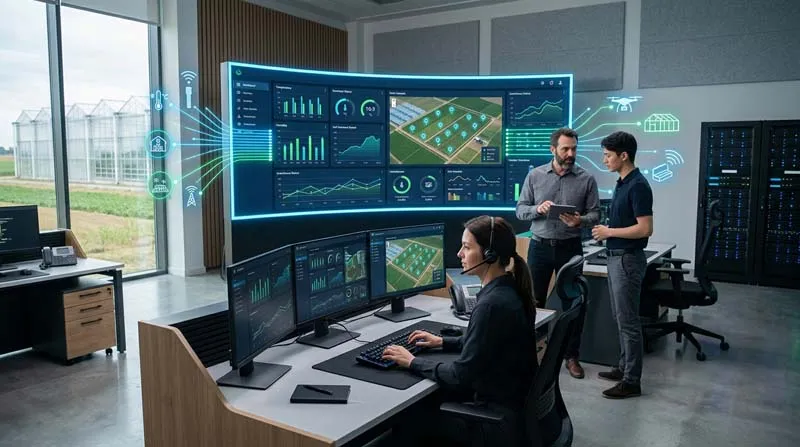
That is why smart agriculture needs a more connected system. IoT + AI Sensors create that system by turning the farm into a visible and manageable environment. Sensors collect field data, networks transmit it to a platform, and control units act on the results. Consequently, managers no longer depend only on experience. They can make decisions based on real conditions and real timing.
How IoT + AI Sensors Build a Closed-Loop Farm System
The real strength of IoT + AI Sensors lies in closed-loop control. First, sensors detect key environmental factors such as soil moisture, air temperature, humidity, carbon dioxide levels, and light exposure. Next, the system sends that data to a digital platform for analysis. Then, control equipment responds by adjusting drip irrigation, ventilation, or supplemental lighting.
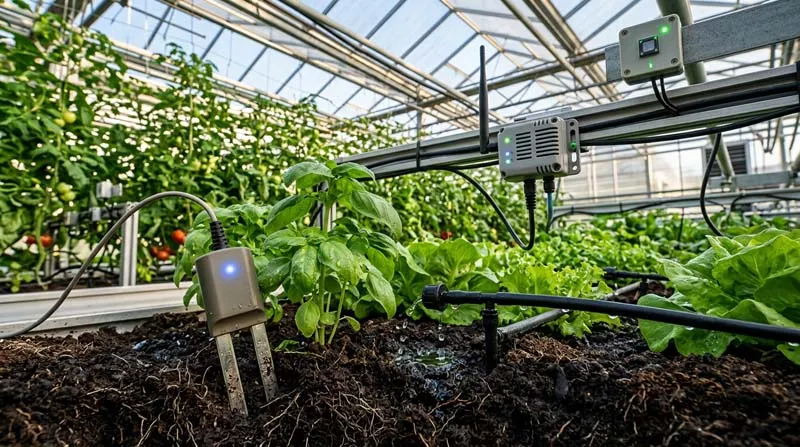
This process makes farm management more precise and more efficient. For example, the system can irrigate only when the soil reaches a defined threshold. Likewise, it can increase airflow when greenhouse heat rises too quickly. Instead of using fixed schedules, farms can match operations to actual crop needs. As a result, they reduce waste while improving consistency across the growing cycle.
A Smart Farm in Jiaxing Shows the Value Clearly
A smart farm in Jiaxing, Zhejiang, offers a strong domestic example. The project uses IoT + AI Sensors to monitor soil, air, and light conditions across greenhouse operations. At the same time, it connects these readings to automated drip irrigation, ventilation, and lighting systems. This structure allows the farm to manage daily operations through real-time data rather than repeated manual inspection.
The results are impressive and highly practical. One person can manage 100 mu of greenhouses. Meanwhile, water utilization has increased by 40%, and crop yield has risen by 20%. These figures show that smart agriculture is no longer a distant concept. Instead, it is already delivering measurable gains in labor efficiency, resource use, and production performance.
From Experience-Based Farming to Data-Driven Decisions
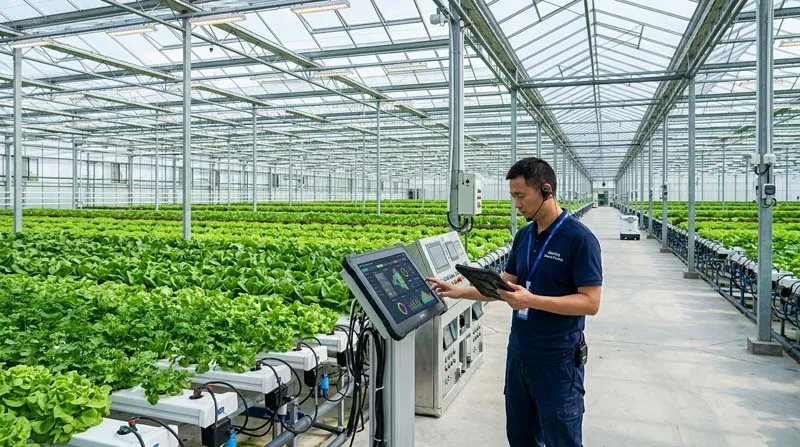
The deeper value of IoT + AI Sensors is not limited to automation. More importantly, they change the logic of agricultural decision-making. In traditional settings, many actions happen after a problem becomes visible. A farmer may irrigate after crops show stress or ventilate after heat has already built up. By contrast, data-driven systems act earlier and with greater precision.
This shift improves more than speed. It also improves planning, consistency, and risk control. Because farms can track environmental trends over time, they can refine irrigation strategies, optimize greenhouse conditions, and build stronger operating standards. In addition, data records make production easier to review and improve. Therefore, IoT + AI Sensors support not only smarter farming today, but also better management tomorrow.
Clear Business Benefits: Lower Costs, Better Yields, Stronger Quality
Any technology must prove its value in real operations. Fortunately, IoT + AI Sensors offer a clear business case. First, precision irrigation reduces unnecessary water use. Second, automated environmental control cuts labor demand and lowers management pressure. Third, stable growing conditions help crops develop more evenly, which supports higher yield and better quality.
These benefits matter even more for large-scale greenhouse farming and high-value crops. Labor shortages continue to affect agriculture, while buyers demand consistency and traceability. Under these conditions, smart systems create both operational and market advantages. Moreover, they help producers improve profitability without relying only on expansion. For many farms, IoT + AI Sensors are becoming a strategic tool for long-term competitiveness.
The Future of Smart Agriculture Will Be More Connected
The next stage of smart agriculture will go beyond monitoring a single greenhouse or managing one irrigation zone. In the future, farms will connect sensing, control, prediction, and traceability into one integrated system. As digital platforms grow stronger, they will support forecasting, anomaly detection, and deeper optimization across the full production cycle.
At the same time, application scenarios will continue to expand. Greenhouses are an important starting point, but orchards, tea plantations, grain fields, aquaculture sites, and cold-chain facilities can also benefit. Therefore, IoT + AI Sensors will not remain limited to one segment of agriculture. They will become a core layer of digital infrastructure for the broader rural economy.
Reliable Connectivity Matters as Much as Smart Sensing
Smart agriculture depends on more than sensors alone. It also needs stable communication, reliable platforms, and durable device integration. In that broader ecosystem, companies with deep IoT expertise play an essential role. EELINK Communication is one such enterprise. It focuses on applying wireless communication technology to the Internet of Things and has spent more than 20 years developing and manufacturing IoT hardware and software solutions.
Its product range includes remote monitoring platforms for temperature, humidity, and related field data. In addition, its services extend across asset management, vehicle anti-theft, insurance sales, and cold-chain transportation management. EELINK Communication continues to push innovation in response to changing customer needs. By delivering efficient and reliable solutions, the company helps create real value in connected industries. In an era shaped by intelligent infrastructure, that capability will remain increasingly important.