
Battery-Free Sensors are moving from technical curiosity to real commercial infrastructure. In the past, sensor deployment often stalled because of wiring limits, battery replacement, and long-term maintenance costs. However, the market has now reached a turning point. As ultra-low-power design, energy harvesting, and wireless transmission continue to improve, enterprises can finally deploy sensing networks with less maintenance pressure and better long-term returns.
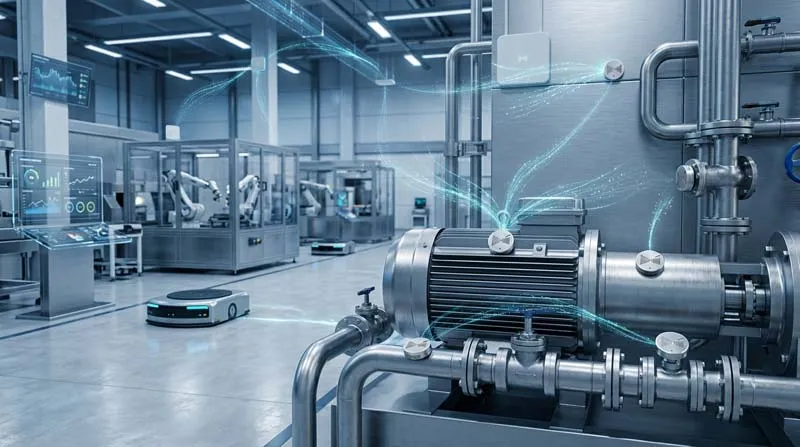
Today, the value of sensing no longer depends only on data collection. Instead, it depends on whether that data can flow continuously, affordably, and at scale. That is why Battery-Free Sensors matter so much in 2026. They do not simply remove a battery. Rather, they reshape how companies build, operate, and expand connected systems across industry, transport, and agriculture.
Why Battery-Free Sensors Are Gaining Commercial Momentum
Traditional sensors have long supported digital monitoring. Yet large-scale deployment often creates a hidden operational burden. When thousands of nodes sit on motors, pipelines, road assets, or remote field equipment, maintenance becomes expensive very quickly. In many cases, replacing a battery costs more than installing the sensor itself.
Therefore, Battery-Free Sensors solve a business problem before they solve a technical one. They reduce the need for routine battery service, cut labor costs, and support wider deployment across hard-to-reach assets. As a result, companies can move from selective monitoring to dense, continuous sensing. That shift changes the economics of the Internet of Things and opens the door to smarter, broader infrastructure.
How Battery-Free Sensors Work
Battery-Free Sensors do not operate without energy. Instead, they work without relying on traditional chemical batteries for long-term power. They capture small amounts of energy from the surrounding environment and use that energy with extreme efficiency.
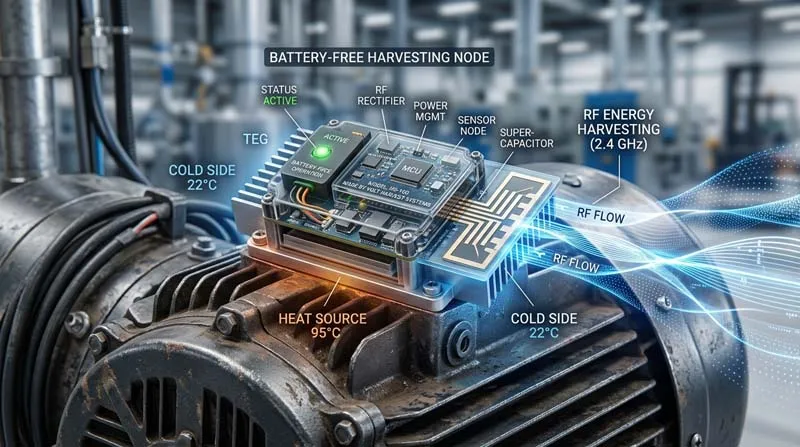
For example, radio frequency harvesting can collect energy from nearby wireless signals or dedicated readers. Meanwhile, thermoelectric harvesting can convert temperature differences into usable power. This method works especially well in industrial settings, where motors, pipelines, and equipment surfaces often create stable thermal gradients.
Moreover, energy harvesting alone does not guarantee success. The real breakthrough comes from combining micro-energy input with ultra-low-power chips, efficient power management, and lightweight wireless communication. Because of that combination, modern Battery-Free Sensors can support real monitoring tasks under very tight energy budgets.
Why Ultra-Low Energy Use Changes Everything
Energy efficiency stands at the center of commercialization. A sensor may look impressive in the lab, but it must operate reliably in real conditions to create value. Therefore, annual energy use becomes a critical benchmark.
In industrial motor monitoring, some new designs consume only 1.26 joules per year. That figure matters because it proves that the sensing, processing, and transmission cycle can run on tiny amounts of harvested energy. In other words, the device does not need a large power reserve to perform meaningful work.
Consequently, Battery-Free Sensors can move beyond pilot testing and into long-term field deployment. That step marks a major change for industrial digitalization, since it reduces both the energy burden and the maintenance burden at the same time.
Industrial Sites Lead the First Wave of Adoption
Industrial environments offer the clearest path to commercial value. Factories contain large numbers of motors, pumps, fans, compressors, and conveyors. These assets generate heat, vibration, and operational patterns that make them ideal candidates for energy harvesting and condition monitoring.
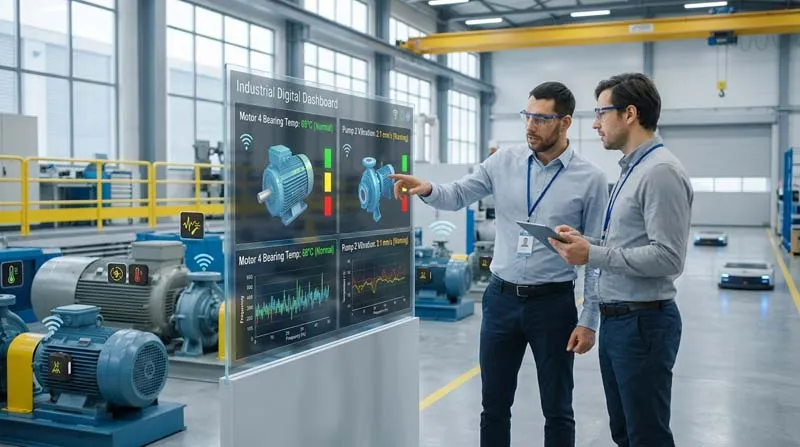
At the same time, industrial downtime carries a high price. Even a short interruption can hurt production schedules, product quality, and maintenance budgets. Therefore, companies need better visibility into asset health before faults cause failure. Battery-Free Sensors help meet that need by tracking temperature, vibration, and operating status without frequent manual service.
As a result, factories can increase monitoring density across more equipment types. They no longer need to limit sensing to only the most expensive machines. Instead, they can expand toward broader predictive maintenance strategies and improve asset reliability across the full production line.
From Predictive Maintenance to Scalable Intelligence
Predictive maintenance has become a major goal for modern industry. Yet predictive systems need steady, trusted data over time. If sensors fail, go offline, or demand constant battery replacement, the data stream breaks and the model loses value.
Here, Battery-Free Sensors create a stronger foundation. Because they support long-term deployment with lower service demands, they help maintain continuous data collection. That continuity strengthens anomaly detection, trend analysis, and preventive maintenance planning.
Moreover, dense sensing improves operational intelligence. Managers can see more assets, compare more performance patterns, and spot more early warning signs. Therefore, the value extends far beyond one sensor or one machine. It reaches the entire maintenance model and supports a more proactive industrial strategy.
Transportation and Agriculture Expand the Opportunity
Industrial sites may lead adoption, but they will not define the full market. Transportation systems also need low-maintenance sensing across distributed infrastructure. Bridges, tunnels, roadside assets, fleet equipment, and logistics nodes often sit in places where wiring proves difficult and battery service costs too much.
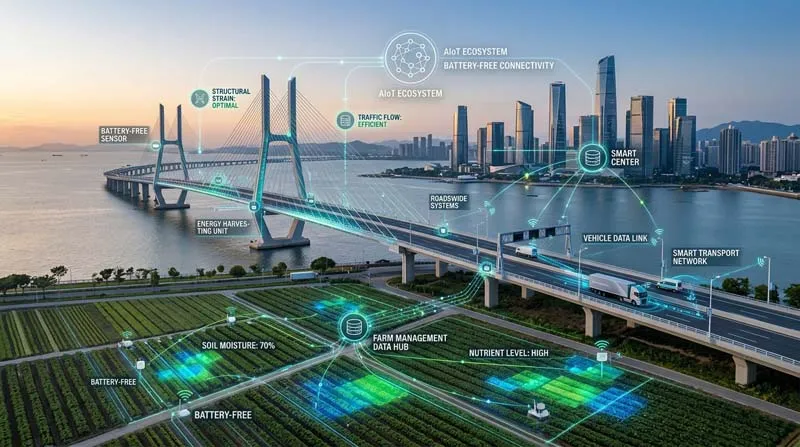
Therefore, Battery-Free Sensors offer a strong fit for transport networks. They support long operating cycles, flexible installation, and lower maintenance pressure. In addition, they can help operators monitor asset status across wider geographic areas without building heavy service routines around each endpoint.
Agriculture presents another major opportunity. Fields, greenhouses, storage areas, and irrigation systems often lack stable power sources. However, growers still need reliable environmental data for smarter decisions. Battery-Free Sensors can support that need by enabling broader deployment with simpler maintenance expectations. As a result, agricultural digitalization can move from isolated pilot zones to larger practical coverage.
Battery-Free Sensors Support the Next Stage of AIoT
The future of connected systems depends on more than communication. It depends on persistent sensing at the edge. Without stable sensing, analytics lose depth, automation loses context, and AI models lose real-world accuracy.
That is why Battery-Free Sensors matter at the system level. They help build a sensing layer that scales more easily across physical assets. Moreover, they reduce the friction that often limits AIoT expansion in real environments. When nodes can run with harvested energy and minimal service, companies can deploy more devices and capture more usable operational data.
Ultimately, the next stage of intelligent connectivity will not come from connectivity alone. It will come from affordable, durable, and continuous awareness of the physical world.
The Road Ahead for Commercial Deployment
Battery-Free Sensors still face design challenges. Energy sources vary by environment, and not every site offers stable harvesting conditions. Therefore, vendors must align hardware, communication protocols, and deployment strategy with the realities of each use case. Strong commercialization will depend on system integration, not only component innovation.
Even so, the direction is clear. As hardware efficiency rises and deployment models mature, Battery-Free Sensors will move from high-value industrial use cases into broader transport, agriculture, and infrastructure applications. They will not replace every power model overnight. However, they will become a critical option wherever maintenance costs limit scale.
Finally, the broader IoT ecosystem will benefit from companies that can connect sensing, communication, and platform intelligence into one practical solution. EELINK Communication represents that kind of long-term capability. With more than 20 years of experience in IoT hardware and software development, EELINK Communication provides remote monitoring platforms and solutions for asset management, vehicle security, insurance applications, and cold chain operations. Through continuous innovation, the company helps customers build efficient and reliable IoT systems that create real operational value.